
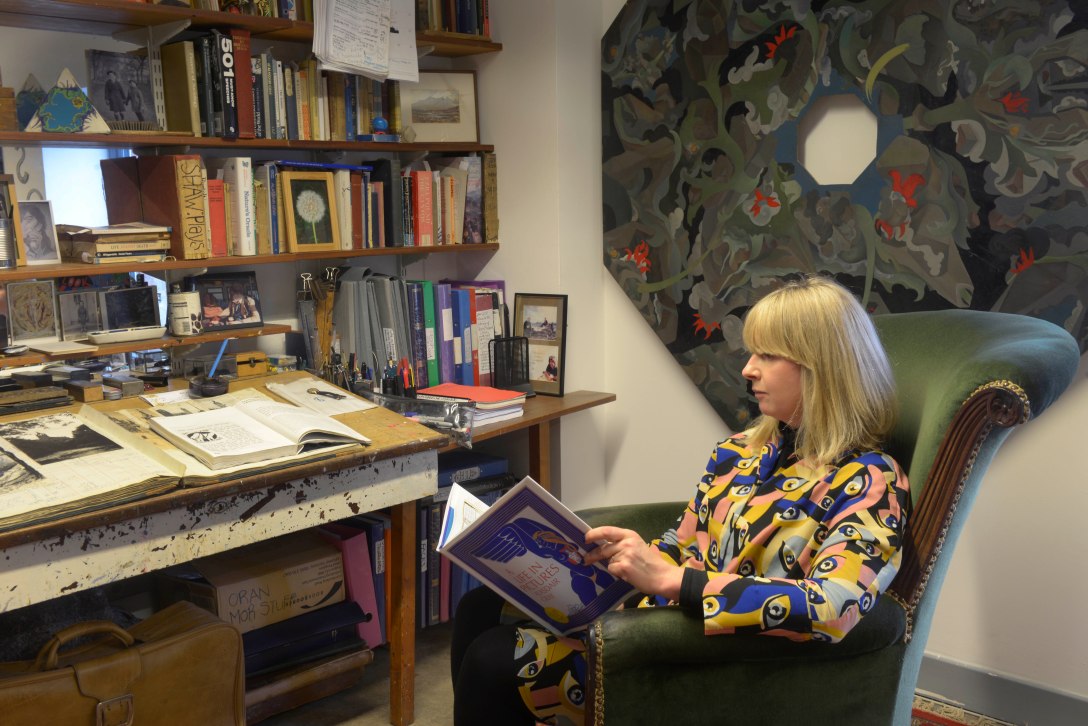
In December 2019 we heard the news that one of Scotland’s best-loved writers and artists, Alasdair Gray, had passed away at the age of 85. Since then, Sorcha Dallas has been working hard to establish the Alasdair Gray Archive, with the aim of preserving Gray’s collections and celebrating his prolific life work.
In this interview we speak to Sorcha about her personal connection with Alasdair, her exciting plans for the Alasdair Gray Archive, plus a new initiative to celebrate ‘Gray Day’ (the original publication date of Gray’s famous novel Lanark) alongside Canongate Books on the 25th of February.
As Sorcha explains, the new Archive will be established at a physical studio space in Glasgow, fitted out with Gray’s books, paintings and sketches, and replicating the feeling of Alasdair’s own workspace. Altogether, the new Archive will ensure that Alasdair Gray’s legacy continues to continue to inspire – from exhibitions, loans to public galleries and museums, as well as supporting the work of new artists.
Could you start by telling us a bit about your own background and your connection with Alasdair Gray?
I graduated from the painting department at Glasgow School of Art in 1998. Between 1999-2004 I co-founded and curated the moving gallery Switchspace, which delivered a programme of exhibitions showcasing Glasgow based artists, at varying stages in their careers, in ever-changing unused spaces throughout Glasgow.
The support and interest Switchspace generated evolved into the establishment of my permanent gallery space, Sorcha Dallas, to offer a sustainable support structure for a new generation of emerging artists based in the city which I ran from 2002-2011. My working relationship with Alasdair goes back to 2008 when I was running my commercial gallery, however my interest began many years before whilst studying at GSA and reading Lanark.
I was also aware of how Alasdair’s work permeated through the West End of Glasgow, an area in which I have lived most of my adult life. I had encountered his murals in The Ubiquitous Chip restaurant and bar, within the auditorium of Oran Mor, found his carefully designed books in the former Byres Road booksellers John Smith’s, and had snatched glimpses of his distinctively styled paintings through tenement windows. So from the start I was aware of his expansive practice and how this had never been formally accessioned.
I was prompted to start to look at this in relation to his visual archive as he was working on A Life in Pictures with Canongate. I helped him collate and locate details of works he wanted to feature and created a system which detailed further information on them such as year, medium and owner. This then became a starting point to try to map his wider works, beginning with the ones he had at home and then expanding to take into account works in public and private collections.
This was invaluable to work from when planning The Alasdair Gray Season, a city wide series of exhibitions and events that I devised for Glasgow Museums in 2014/15, the central show being the retrospective ‘From the Personal to the Universal’ at Kelvingrove Art Gallery and Museum.

An archive for Alasdair’s work seems like such a wonderful and necessary idea. How did the idea for the project come about?
When I started working with Alasdair he was in his 70s so I was very much aware of his legacy and recording his thoughts for how best to preserve this posthumously. Over the years we formalised this by way of a Foundation, and we secured charitable status with one aim being the creation of an archive for future generations.
We applied for funding to help support and digitise his archive but had limited success. I continued to work on this voluntarily (after I closed my gallery in 2011) but was limited in what I was able to achieve. Since his accident in 2015, Alasdair had been severely restricted in what he was able to create visually. He was in a wheelchair, which affected his ability to paint and draw at any large scale. He was desk bound and his output became focused on his translations of Dante and accompanying illustrations (which he had started before his fall).
After Alasdair’s passing there was an urgency in getting his affects secured as we had a three month window in which to do so and vacate his property. I had to move quickly to organise and secure partners, with the support of Alasdair’s family.
Elements of the archive were taken into temporary store by several institutional partners which we hope will secure them longer term. The Scottish Government stepped in to support the premises for the Archive at The Whisky Bond in Glasgow, and the safe installation of Gray’s materials there. The week before lockdown saw the final packing and removal of Alasdair’s works into the space.
It was a strange time, the feeling of a collective breath being held and unsure, once exhaled, what the world would look like on the other side. It felt very much like the end of things and it was very difficult to say a final goodbye to Alasdair’s flat and a space I had the privilege of being in so many times.
“It has been a great source of comfort and inspiration in such a challenging year.”
But in the midst of all this uncertainty it was reassuring to have the anchor of Alasdair and his work. It has been a great source of comfort and inspiration in such a challenging year and I have been grateful for the hope it has offered at such an uncertain time.
The Archive will seek to generate opportunities from Alasdair’s work – this could be new, interpretative or critical interpretations and commissions. A central aspect is audience development, with a focus on education. Alasdair would often talk about the formative cultural experiences he had as a child and it seems key to create this for others in Alasdair’s name.
The Archive’s hopes are very much in the spirit of all things Gray – to create democratic, questioning and equitable opportunities and foster the idea of community and kindness. It will be exciting to see how these develop moving forward as there is so much scope with the scale and breadth of what Alasdair has left behind. I feel very fortunate to be the custodian of such a rich resource and am hopeful for what it can help us learn in the future.

On the archive site you talk about using Alasdair’s work to explore Scotland’s collective identity. Could you tell us more about that idea?
Alasdair Gray was a true polymath with his unique vision spanning multiple mediums. He made poems, plays, short stories, novels, political essays, marginalia, typeset and designed his books and those of others, created murals, paintings, drawings and prints.
“Alasdair Gray was a true polymath.”
He taught creative writing and visual art whilst actively championing those around him. He was a proud supporter of socialism, believing in a fair and equitable society. He lived by these principles, paying assistants at the same rate of pay as himself and valuing the ability for everyone to have the right to the freedom of thought that culture provides. This was most notable in his support of libraries and the belief in the transformative power of literature and the arts. As a child he would use books to travel and experience different worlds and cultures from his bedroom in Riddrie.
This had a profound effect on Gray and is a cornerstone of the aims and objectives of the Archive. To offer that space to others, to learn about themselves and others, and to travel back inspired by what they have learnt and to explore our collective identity through this process.
So many people seem to have their own memorable stories from meeting Alasdair – is that something you’d like to collect as part of the archive?
Absolutely. The fact that Alasdair meant so much to so many is essential to capture. He was well known for backing up a book signing by doing personal dedications and drawings, as well as sketching and giving away portraits to folk he encountered. This generosity and interest in connecting with others means there is a rich resource of personal memories to now capture.
I am developing ways of doing this digitally via the Archive website and also through physical visits to the space (when it is safe to offically open). One way I am starting to capture this now is via the podcast, Gray Matters and Wee Gray Matters (aimed at children).
I am working on these with Ali Braidwood from Scots Wha Hae who has been integral to faciliating these programs and making them happen. They will initially look at Lanark (to coincide with anniversary plans for 2021/2022) but the hope is to extend them beyond this and to explore Gray’s wider extended practice. We will be launching these on Gray Day!

Will Gray Day become an annual event? How should people celebrate?
I would love it to become an annual event! People can change their avatar on the day to the Gray Day logo, they can share memories, photos, stories and clips using the tagging #GrayDay, The Archive and Canongate so we can spread the word, celebrate and share. There will be content released on the day itself and in the lead up so please sign up and follow www.grayday.info.
You’ve just announced a very exciting studio space people can visit and get a feel for Alasdair’s old workspace. Why did you think this aspect of Alasdair’s process needed to be preserved, rather than just his finished books and artwork?
Alasdair was a true polymath, creating work across space and form. Anyone who visited him at home will remember what a unique working and living space he occupied. Shelves were crammed full of books, paintings displayed on every wall, sketched boards stacked on the floor and layered on ledges, rows upon rows of potted pens and pencils, shells covering fireplaces, sculptures and artworks of others arranged, works in process being tippexed and altered on desks and easels.
I vividly remember the first time I visited his flat and how I had to almost catch my breath at what I encountered. His space gives a unique insight into his expansive working practice and it was essential to capture, record and recreate this for others to experience and learn from.
The Archive holds the collection of original visual artworks, sketches and drawings bequeathed to Gray’s son Andrew and held there for research and learning purposes. It also houses all Gray’s original prints, a restaging of his working studio set up, a section of his personal library, all Gray publications (including those he designed for others) as well as a section of literary papers, photographs and correspondence. When it is safe to do so the new space will be open to the public for bookable visits and through the developing website.
This extensive collection will allow the Archive to present Gray’s work in the future in a number of different contexts; through exhibitions, long term loans to public galleries and museums as well as acting as a catalyst for new commissions. The Archive will also hope to act as a centre for research, allowing a unique, unparalleled opportunity for students, academics and the wider public to gleam a fuller understanding of the expansive nature of Gray’s practice and the invaluable contribution he made to 20th century culture. A core aim will be to support others by means of a series of tiered awards and to create new audiences through engagement and commissioning opportunities.
See more from the Alasdair Gray Archive at thealasdairgrayarchive.org
Photography by Alan Dimmick

 The Scots Curator